This is the story of strike action from my book I taught them to cook. As a young teacher I couldn’t afford to lose a day’s pay to go on strike. And I didn’t believe that strike action was the right way to get better pay and work conditions – my students missed out on valuable teaching days. So here is my story from that time.
Black leg
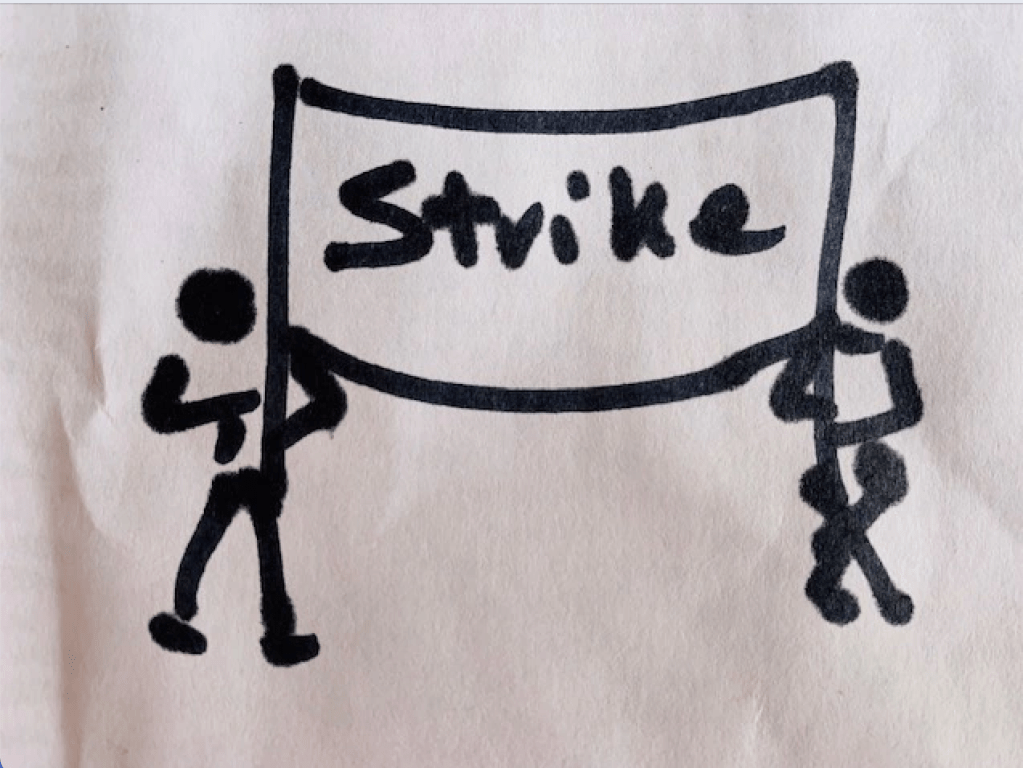
My local rep is holding a NUT meeting in the Town Hall. For months there have been rumblings of discontent. Teachers are disillusioned with pay and working conditions and want change. I squeeze into the back of the gloomy hall. There are no spare seats and people are jammed together. The fat man on the stage thumps his fist on the table and rallies us to take strike action. All NUT members must come out. ‘Ra! Ra!’ the audience chant. I hope no one notices that I don’t join in.
When I started teaching, I’m told to join a union, to support me in difficult times and help me get a fair deal. I sign up and pay my dues, unaware that I have a choice. Now, in the news, there are plans for widespread strike action. Is it going to be like the TV comedy ‘The Rag Trade’ where Miriam Karlin shouts the catchphrase ‘Everybody Out!’?
We get a memo when the strike is planned.
‘On strike day, the school will stay open for teachers who do not belong to unions or have joined professional bodies and those who are not striking. Students are not allowed into school as there will be no supervision.’
The staffroom bustles with placard making and banners ready for the march. I don’t want to go. If I strike I lose my pay for the day, which I can’t afford to do. But deep inside I can’t do it. I don’t want to march on Parliament. Surely change can be effected without this thumping, shouting and marching? I tell the union rep that I’m coming into school. He looks bewildered and cross.
Then things get nasty.
As I’m taking a class, someone thumps on my classroom window and shouts ‘Scab.’ The students watch me for a reaction. I’m shocked, ashamed and voiceless at this angry protest. Things get nastier. More bangs on my classroom window, this time it’s ‘Blackleg.’ The union rep sees me at the end of the school day.
‘Jenny, I suggest you follow the rest of us.’
On strike day I come to school. I’m dragging wet tea towels and dishcloths out of the spin dryer when Len comes into my room.
‘Len, you’re not supposed to be in school. Students stay at home today.’
‘Shall I make us a cup of rosy lee, Miss?’
I know he’s teasing me with his Cockney rhyming slang and perhaps he’ll share some more phrases for me to laugh about. It’s just the two of us in my cookery room and I’ve no lessons and no friends in the staffroom. Len busies himself putting the kettle on and searching for cups, saucers, a milk jug and a teapot. The atmosphere is sad. Len seems sad, and I’m sad. He puts the teabags into the warmed teapot and leaves it to brew, then gathers an armful of my wet dishcloths and hangs them on the bars of my gas-fired dryer.
Len sometimes stays behind and helps me clear up and never takes his cooking home. I wonder if, like me, there is no-one to welcome Len after school. Somehow it feels like Len and I have things in common and we offer each other wordless support. What will happen when he leaves school at Easter as he’s sixteen, barely able to read and write and with no qualifications? Len pours the tea and stirs three large spoonfuls of sugar into his cup and we sit and drink together.
‘Len – I’ve done a bit of Cockney writing – can I read it to you?’
He looks up, puzzled.
‘See if you can understand what I’ve written.’
‘There was this man who went to the bathroom for a jimmy, then had a butcher’s in the mirror and brushed his barnet. He came down the apples and pears, sat down and switched on the custard then the dog and bone rang to ask where was his Duke of Kent so he got in the jam jar and took the man a ton.’
‘Did you understand it, Len?’
He shrugs and looks bewildered at the non-striking teacher that he’s found in school today.
‘Len, let me explain what it means. Jimmy stands for jimmy riddle – piddle, butchers comes from butcher’s hook – look, barnet stands for Barnet fair – hair, apples and pears – stairs, custard stands for custard and jelly – telly, dog and bone – phone, Duke of Kent – rent, jam jar – car, and a ton is £100.
So, there was this man who went to the bathroom for a piddle, looked in the mirror and brushed his hair. He came down the stairs, sat down, switched on the telly then the phone rang to ask for his rent, so he drove his car and took the man £100. Do you think I’m going to be able to speak Cockney Len?’
He’s baffled.
‘Miss, you know that jumper you wore for that staff hockey match? It said Bristol University on the front. You do know that Bristol means Bristol City and in Cockney that means titties? You went to a university for tits. That’s why everyone laughed.’
Thanks, Len for reminding me of a deeply embarrassing moment.
On TV that night I watch the strikers marching from Trafalgar Square, waving banners and placards. Then fighting starts as strikers and police come face to face. What will my days be like if I don’t protest and strike with the majority? It’s a worry for my future.
The next day in the staffroom, they’re very excited.
‘Did you see me knock off the policeman’s helmet?’
It’s Lynn who only last week invited me round for tea in her lovely family home.
The next time the union calls us out on strike, I won’t go into school. Money will be deducted from my wages and I’ll spend the day wandering around Hampstead Heath, far away from this mess. It is time to leave the union. Being called a Scab and Blackleg is too much.







 Jenny Ridgwell