This is my story of a Chocolate Mousse lesson in school 1973.
We bought the ingredients for the class – eggs and cooking chocolate, BUT white eggs from the 1950s to 1960s were being replaced with brown eggs. And students thought brown eggs were healthier and best.
‘Class. We’re making chocolate mousse. Bring a plate and collect an egg and a piece of chocolate.
This should be easy but there’s a kerfuffle. Jimmy bangs his fist on my table.
‘Miss, they’ve taken all them brown eggs and I’m not using them white ones. Me mum only buys brown eggs now. They’re healthier and fresher.’
The remaining queue mutters agreement.
‘Class, come and sit round my table. Jimmy – all eggs are the same. You don’t eat the shell.’
‘Miss, brown eggs are natural, I want one of them.’
‘Look, Jimmy we’ll sort something out. We need to know how fresh they are. There’s no information on the box so you must each come up and do the freshness test.’
There’s a large jug of salted water on my table.
‘Put your egg gently in the water. If it sinks it’s fresh, if it floats it’s too old and we’ll throw it away.’
One by one the eggs get tested, dark brown, light brown, the cream and white shelled ones. One by one they sink.
‘See they’re all fresh and the inside’s the same. Trust me Jimmy this time. ’
Back in their places, I see Jill swap her brown egg with Jimmy’s white one. That’s so kind.
‘Class. Let your chocolate melt in a small bowl over a saucepan of water. Then the tricky bit. Separate the egg white and yolk into two bowls. Cool the chocolate, stir in the yolk, then whisk the egg white until it’s stiff.’
‘Fold the egg white into the chocolate a spoonful at a time. Don’t lose the air. Spoon into a glass dish and chill.’
It all sounds so simple. We watch as fluffy and runny dishes of chocolate mousse get stacked in the fridge. Or on the windowsill when we run out of room. Soon they set and we’ll plop on a glacé cherry and an angelica diamond.
Cynthia hands round teaspoons and they tuck in.
‘Hey class? Why don’t eggs tell jokes?’
I wait a few seconds.
‘Because they’d crack each other up.’
They laugh and for now it doesn’t matter if eggshells are white or brown.
Grace Dent in her best selling memoir Hungry says home economics was the one lesson where she could shine.
Nigel Slater was the only boy in his domestic science class but it took a long time for Miss Adams to teach him to cook.
So do other famous food writers value their cooking lessons at school? The Guild has over 550 members who are authors, broadcasters, columnists and journalists and they are passionate and knowledgeable about food.
I asked if they learnt to cook at school and if not why not.
65% of respondents said Yes and 35% said No.
Many were not allowed to but why? The message was clear. Cooking was not considered an academic subject and clever students, like some Guild members, had to study Latin or science instead. They were actively discouraged from learning to cook.
In high schools and grammar schools only the less academic were allowed to learn home economics. Several begged to take the subject but had to wait until they left school to study for themselves.
A level Domestic Science was not accepted as a qualification for university and others, like me, had to take more exams to make up for this. Clearly, for Guild members, learning about food is their passion and they have a hugely diverse range of job opportunities open to them.
Here are replies from members who loved their lessons.
Liz Trigg says ‘I absolutely loved it and had a great inspiring teacher Mrs Susan Hopps. I then went on to study a Bsc in Home Economics at Cardiff University’. Liz has a successful food media career as a food editor in magazines and writing cookbooks.
Lorna Rhodes replied ‘I loved domestic science at school and did the new course at Salford Tech for Home economics for higher education – led onto a job with Cadbury’s and then freelancing writing and food styling.’ Lorna’s website says ‘Food has been the story of my life!! I have had a successful career as a cookery writer and food stylist for over 30 years having trained as a home economist.’
Charlotte Pikeis an award winning cookery writer, teacher and chef. ‘I did GCSE Food Technology in 2001. I was told off for taking my Mum’s copy of Delia’s Complete Cookery Course in by my teacher! Food Technology was dull.’
Lynsey Hollywood is the manager of the Food & Drink Business Development Centre and Course Director for the MSc Food Design and Innovation at Ulster University Business School. ‘I look back on my HE classes with really fond memories and am genuinely so appreciative of the topics I was taught relating to sustainability, health, budgeting and nutrition as well as the skills I gained in cooking and research.’
Jennifer John runs Ceres PR, a specialist food and wellbeing PR and marketing agency ‘I did O level & A level HE then the National Diploma was a brilliant education all round – in so many subjects!’
Jane Miltonwrites about the food industry and often appears as an expert on television programmes representing the industry. ‘I did O’ grade and Higher Home Ec. In my higher studies chemistry and Home Ec were time tabled against each other as ‘if you are clever enough to do chemistry, you would not do Home Ec.’ The School year book says – Course of Higher Education as they could not bring themselves to say I had gone on to do a degree in HE! ‘
Sam Bilton is an established Food Historian, writer and cook. ‘I did Home Economics as an O level in the 80s. I had a very enthusiastic home economics teacher so I enjoyed it. No one suggested I do Home Economics as an A level. I wish they had as I’m sure I’d have got better results!’
Clare Gordon Smith is a food writer, stylist and editor. ‘I did Home Economics at school, but had to change school to get there as the previous school didn’t think it much of a subject!’
What are the views of food writers who did not study cookery at school?
Angela Cluttonwrites award winning cookery books and runs food events for Borough Market and the British Library and regularly appears on TV. ‘At my school you did either Latin or Home Ec – and this was a decision made by the teachers, not the pupils. The ‘clever’ girls did Latin… Ridiculous and makes me sad even to write it here.’
Liz Wright, editor of the Smallholder Magazine, replied ‘I’d like to have done more but I was academic so they wouldn’t let me – didn’t do me a lot of good, left school at 15 because I hated it.’
‘I went to a Direct Grant Girls’ School in the sixties. No Domestic Science, no sewing. The headmistress apparently didn’t approve.’ Kay has been a book editor for many years and runs a travel gourmet blog.
Not all are glowing about their cookery teachers. Some replies made me chuckle.
Steff Hafferty is a no dig gardener, garden and food writer, teacher, consultant.
‘It was dreadful, taught by a psycho maths teacher and a psycho nun. I learned nothing about making good food’
Sally Butchersays she’s a crazy cornershop keeper. Restaurateur. Masquerades as a chef. ‘My home economics teachers were appalling. I couldn’t wait to drop both classes.Kay Gale ‘I went to a direct grant girls’ school in the sixties. No domestic science, no sewing. The headmistress apparently didn’t approve.’
My conclusions?
Since I started teaching in the 1970s, home economics, domestic science, cookery or whatever else you want to call it, has been challenged. The Guild members describe the enjoyment many found in cooking at school, yet others were stopped from taking the subject and told they were too academic and had to do other things. Learning about food deserves more respect. Well done to those Guild members who found a way in later life to get qualified and earn their living working with food.
In 2021 there is a shortage of people needed in the hospitality and catering industry, our weekend papers are packed with food news and recipes, and the public demands good quality food in supermarkets and restaurants. But our food teachers still struggle with lack of technician support for their busy classrooms and need help funding ingredients so that all students in their classes can cook. Somehow we need to wave the Food flag and hope that schools of the future give students a chance to learn about this amazing subject that has been such an important part of my life for the last fifty years!
It’s the weekend. I’m back in Kettering and visiting my grandmother to get some free rhubarb from her garden for my lessons. The pink, tender stems that she forces under metal buckets are saved for the family but she’s happy for me to pick the huge clumps thriving on her compost heap. I cut armfuls – leaves and all – but Grandma’s bothered.
‘Those rhubarb leaves can poison people.’ She’s heard a story of someone who ate the leaves, had severe stomach pains and ended up in hospital. Grandma boils the leaves with water to make her aluminium pans shiny clean and she reckons that if the leaves strip your stomach in the same way as they remove stuck bits from her pans, then that could be painful.
‘Don’t give those children the leaves. You could get into trouble.’
‘Don’t worry – I’ll warn them.’
Grandma knows about London children. Evacuees from east London were billeted in her house during the Second World War. They attended Park Road Infants School, thrived on her cooking and helped with her garden. She’s very proud of her certificate from Queen Elizabeth II thanking her for this service, which she keeps in a faded envelope with its official stamp in her treasured front room cabinet.
‘Just a word. Have you got another boyfriend yet? Time’s passing Jenny. This job is not everything you know. Make time to watch the flowers grow.’
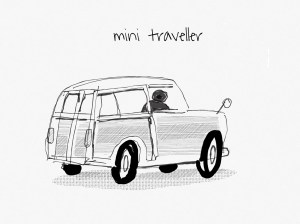
Bah. I’m twenty four, everyone is getting married, I live alone in a dismal Hampstead bedsit and drive an old Mini Traveller with green moss, which matches the colour of the car’s paintwork, growing on its window edges. And I have a job where most of the time I’m dressed in a nylon overall and matching pink rubber gloves, and I rarely leave the room. Back in the classroom, I plonk the pile of rhubarb on the demonstration table.
‘Class – to warn you – these leaves are poisonous, so don’t eat them. They can give you a stomach ache and some people have died after eating them.’
Who knows if the death story is true? I have their attention.
‘How did they die?’ It’s early but Bert is alert.
‘The leaves contain toxic oxalic acid and that means they are poisonous.’
‘Why does the poison just go into the leaf? What about the rest?’
Bert has a clever point. I’ll have to ask the biology teacher.
‘Miss, can I have those leaves?’
Ah ha. I can see where this diversion is leading. Bert’s after my rhubarb leaf mountain. We’ve just had the school acid attack in the Chemistry lab when a boy was pushed onto a stool covered in nitric acid. It burnt the backside off his school trousers and he was whipped off to Whipps Cross Hospital to have the skin on his bottom soothed. Whispers said Gavin was involved. He was supposed to be going to another school, but it turns out no one will have him, so he could be back in my lessons. Next to enter the school gossip calendar could be the rhubarb poisoning scandal. And it’ll be my fault.
‘Bert, I’m taking these leaves home, so just watch my demonstration on Rhubarb fool that we’re making today and stop plotting. Remove the leaves, wash and chop the stems, put them in a saucepan and cook in a little water with the lid on until they are soft.’
I’m learning to give my classes very clear cooking instructions after several disasters ended in the bin. I once told Robert to boil his potatoes until they were soft so he stuffed them, unpeeled, into my electric kettle, filled it with water and clicked it on. It took ages to poke out the mushy, mashed up bits. For today’s lesson I’ve got a ‘Here’s-one-I-made-earlier’ bowl of Grandma’s pink, cooked rhubarb just like a Blue Peter presenter. It gets passed round the group with little approval.
‘Now to make custard.’
My grandmother and I used to make Bird’s custard together to go with her apple crumbles, gooseberry pies and strawberry jam sponges. There is a magic moment when you stir pale peach custard powder with gritty granulated sugar and mix with a little milk. Suddenly the mixture turns into a bright yellow liquid – a chemical mystery that probably holds its truth in tartrazine.
‘To make the custard, pour hot milk into this mixture and stir quickly until it thickens.’
A golden, glossy custard glimmers in the bowl.
‘Mix together your cooked rhubarb, the custard and some
drops of red colouring.’
The red colouring is made from crushed cochineal beetles but I’m not sharing that secret. Imagine the screams.
‘We ain’t eating beetles.’
‘Whisk the egg whites until stiff and fold in. Spoon into a glass
dish and top with a glacé cherry.’
They chop, cook and stir, beat and mix. Soon my table is covered with glass dishes in various shades of pink. Each served on a saucer with a frilly d’oyley. Always a bloody d’oyley. There are hundreds to use in the storeroom. The lesson is over and we have made a potion of rhubarb with enhanced colours and flavours which richly deserves the name fool. I must ask Cynthia what happened to the rhubarb leaves.
Marguerite Patten’s Cookery in Colour was my first cookery book and I used it for all my cooking exams in the 1960’s. In 2009 I visited her at her home and got my well used book signed. Marguerite was as busy as ever, and at 93 years old, she regularly contributed to BBC discussion programmess on current food issues. We talked about the challenges of cooking in war time, and all the changes in equipment and ingredients that came during the following years.
Marguerite Patten signing my copy of Cookery in Colour
Marguerite gave me a copy of A Century of British Cooking, as I was writing a memoir of teaching in London schools in the 1970s. She has written an astonishing 170 books, which makes my 70 titles seem like a starter. Marguerite worked on the launch of the new pressure cookers which saved fuel in the 1950s – interesting how many things are becoming topical today. She demonstrated the Kenwood Chef when it was invented, and promoted many of the food initiatives in the 50s and 60s – using more wholemeal flour and the soft margarines for cake making.
We talked of offal – Awful Offal my students called it- and remembered stuffed hearts, liver and bacon, and grilled kidneys. Marguerite was involved with many food initiatives, and believed that food should be well cooked and delicious. We sat down to a tea of smoked salmon sandwiches and asparagus rolled in brown bread with cream cheese, followed by homemade fruit cake.
Marguerite was an inspiration to anyone wanting to learn to cook, or write about food. So optimistic, generous and hard working, with a database of stories and memories. I value sharing her memories and sensible opinions on the food we eat.
Marguerite died in 2015 at the age of 99. Jenny Ridgwell
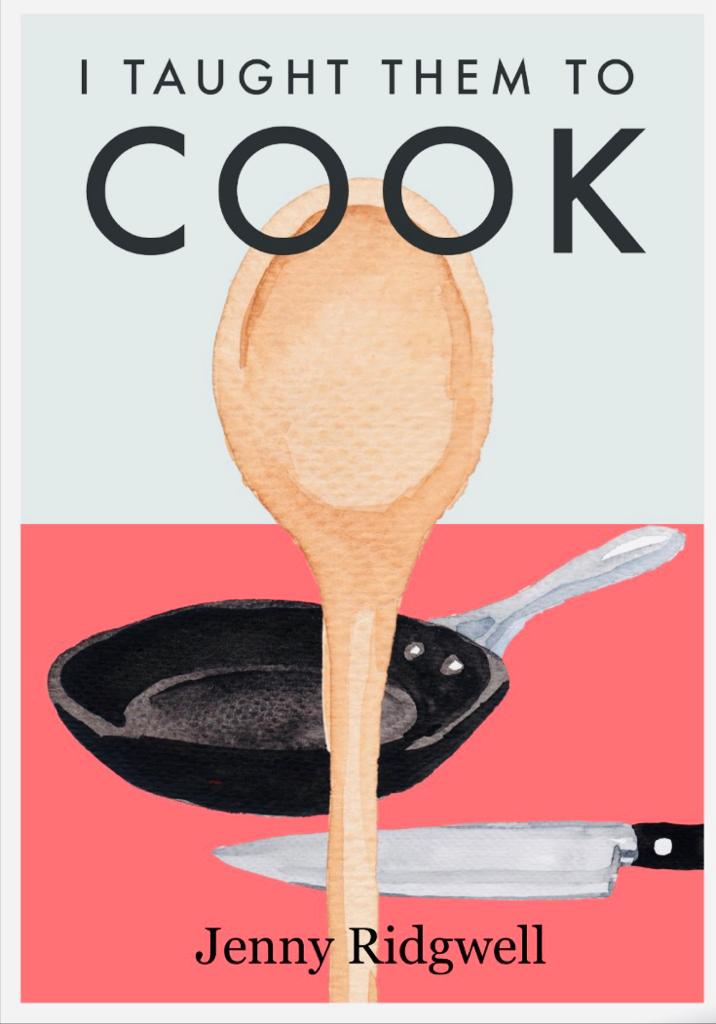
Dave Smith has done some wonderful drawings in the hardback edition of I taught them to cook.
These are images food teachers like:-
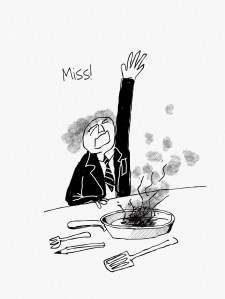
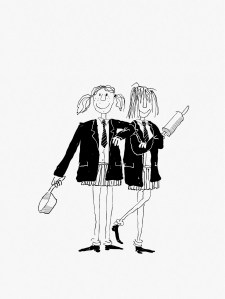
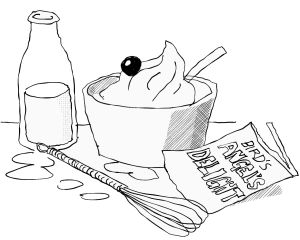
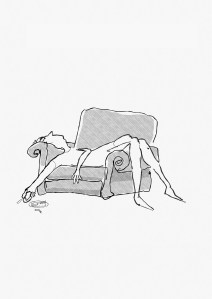
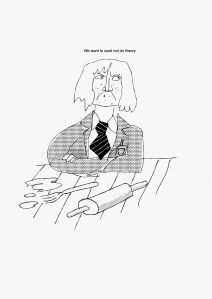
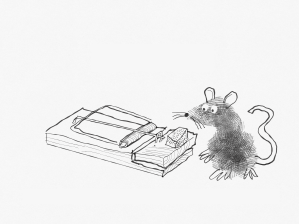
Simon – ‘No help in the Practical exam’ It reminds me of running so many catering exams with half classes of 12 students making 3 dishes each in 3hrs! I felt like a fireman on standby, a paramedic waiting for his first patient and a counsellor consoling students in tears when their gateaux came out as flat as a pancake and would double up as a spare tyre for a Go-cart. Such Fun!!!Sara – This reminds of not only me and my best friend in school when we did A level food but so much of many of the girls I’ve taught over the years. Liza – It’s got to be Angel Delight!!! A favourite in my house and for me growing up. Elizabeth – Angel Delight is my favourite – it takes my straight back to my teenage years and I can almost taste the butterscotch.Manda – I’ve had a really tough half term and this is exactly how I’ve felt for most of it! I loved your book! I found it inspiring. I read it over the summer and it gave me great motivation to persevere with the new phase in my teaching career. Andrea – Having had no practicals last year I am truly exhausted each night after running round all day doing back to back practicals!Heather ‘We want to cook – not do theory!’ My favourite image in your book and made me laugh as it sums up what kids are like most of the time in the classroom when you tell them they are doing theory. So many people have the impression that ‘Home Economics’ is easy and you just do cooking. So they think it is ideal for those who are not academic, whereas we actually do as much theory as practical and you end up with pupils looking like the person in the picture.Adele – ‘A mouse watching me cook’ A couple of years ago school had all of the heating pipes & radiators replaced . They left holes in walls where they shouldn’t have been. We got some new pets in the form of mice.Bea – Liked the mouse story and said ‘I wonder how many circles we have gone around and how many things we are starting to do that you used to and then went out of fashion!!!‘Becky I love the drawing of the mini. I just adore them – I’ve got one now.
Schools went metric in 1971 – that’s over 50 years ago! I threw out the scales measuring ounces and pounds and the jugs with pints and fluid ounces and changed all my recipes to grams and millilitres. Now fifty years ago the UK is still selling milk in pints and beer in half and full pints. Our recipe books are written in metric and imperial according to the Guild of Food Writers whose authors are publishing for 2021.
You can read about my struggle to teach in metric on this link
Students would bring in treasured recipe books with the old measures and tell me that the cake wouldn’t work unless it was measured in ounces! Please can someone decide that we should go completely metric and measure in cm and drive in km!









 Jenny Ridgwell